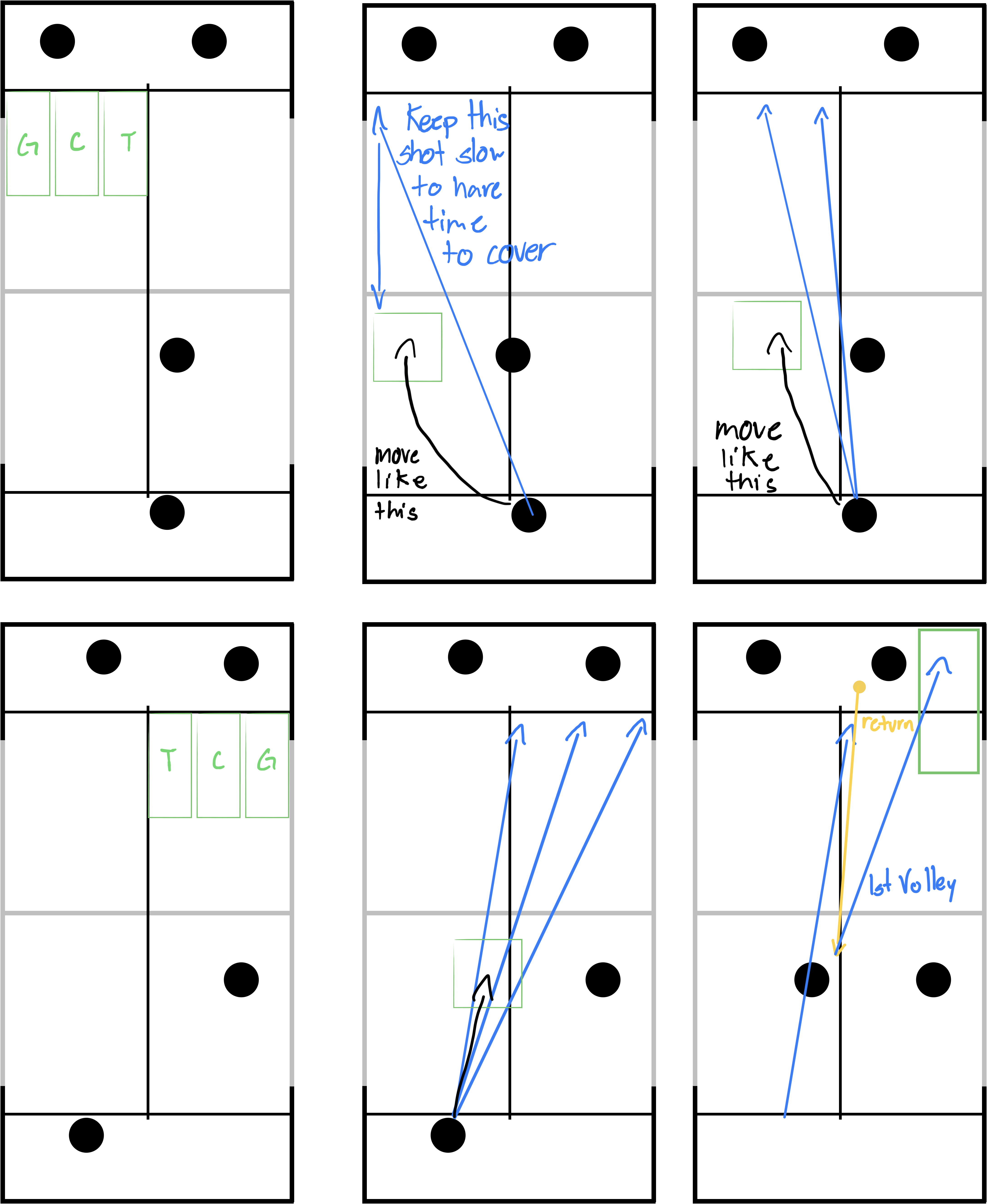
I love padel. If you know me, you know that. This is a collection of tactics, strategies, and insights I've learned about padel. It's designed for me to be able to quickly review them between sets. If you are one of my padel-loving friends, and you think there's something I should add here, let me know please!
To start it off simple, Sanyo said: "En el padel, hay que poner la bola donde toca, a la velocidad que toca y en el momento que toca." That's it, that's padel.
Table of Contents
- Tactics
- Baseline Position
- Net Position
- Shots
- Volea
- Bandeja
- Vibora
- Rulo
- Por tres
- Por cuatro
- Chancletazo
- Globo
- Bloqueo
- Chiquita
- Bajada de Pared
- Serve
- Return
Tactics
Once you're good enough, people don't miss that often making it hard to finish a point and padel fundamentally becomes a tactical game. You need to be capable of identifying space on the court, choosing the right shot in each situation,and spotting weaknesses and strengths in your opponent's game.
Tactics can be divided into position, consistency, moving your rival, knowing your strenghs and finding your rivals weaknesses.
Baseline Position
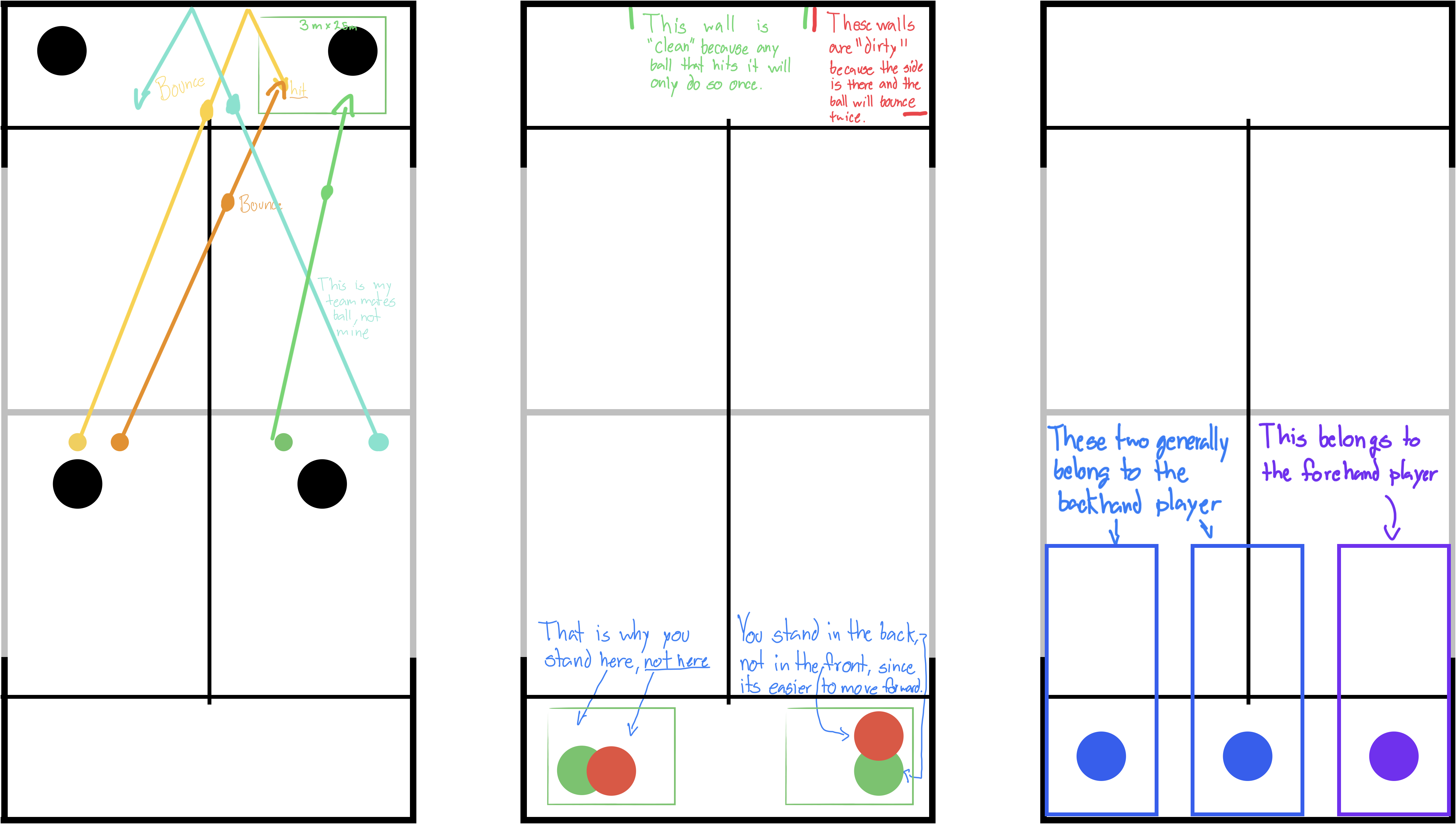
The court is 10m by 10m on each half, but it's not actually as big as it seems. First, you're only responsible for half of it, so that already brings it down to 5m by 10m. Second, the space where balls will be struck most of the time is even smaller, about 3m wide by 2.5m long. Now that that's settled, where in that rectangle should I stand? Where the problems arise, in the corner.
Net Position
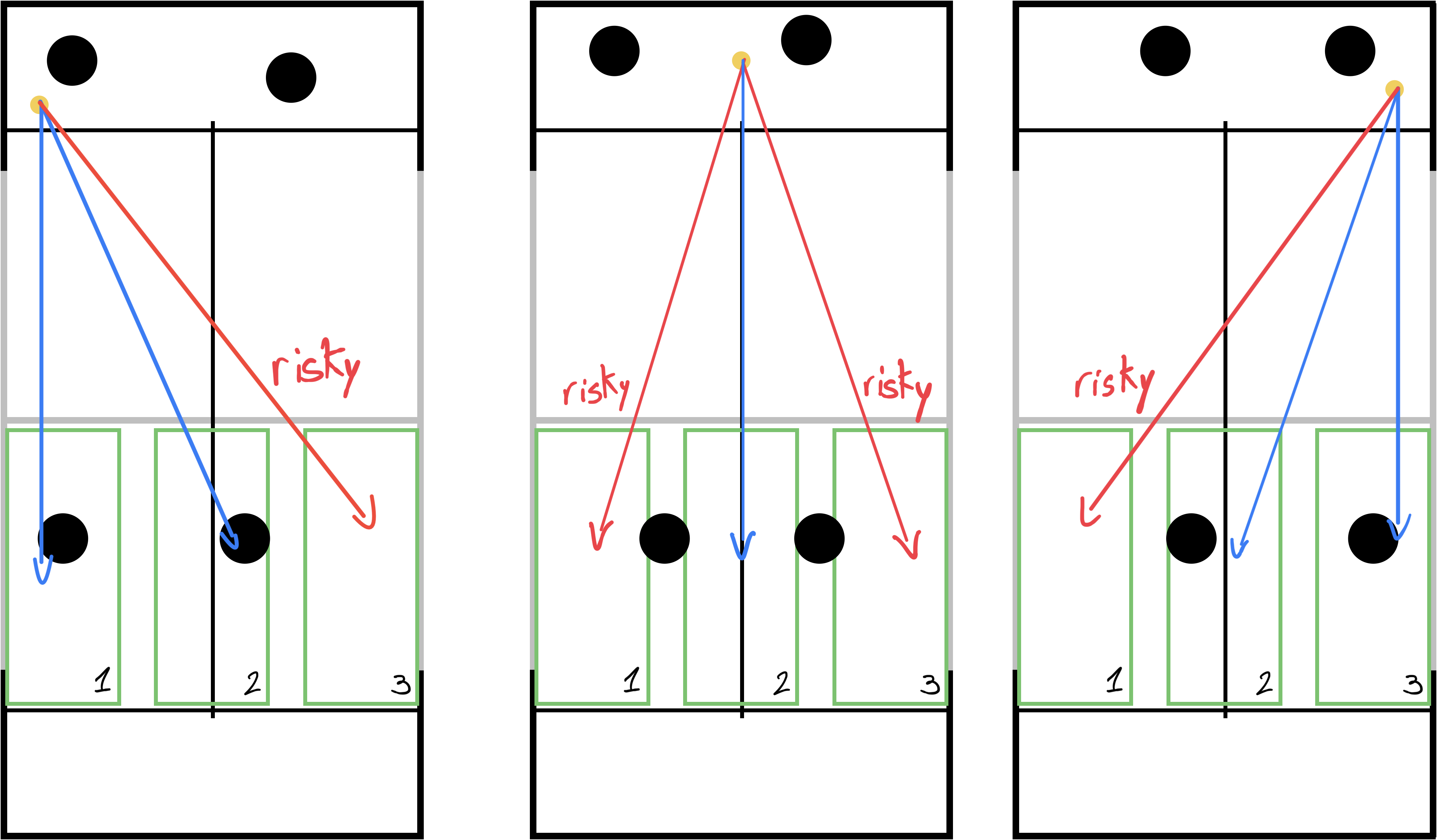
Depending on the position of the ball, the net position of the two players needs to adapt. There's fundamentally three areas and depending on where the ball is, left, center and right. The side that is paralel to the ball and the center are the important positions to cover. Given that a shot to the side of the court that is not parallel to the ball has less angle and is inherently risky for the opponent and thus, it will carry less force and is less likely to occur and to be good.
Shots
Yep, all the shots names are in Spanish. Many of them don't have an English translation, but being totally honest, they simply sound better in Spanish.
Volea
Bandeja
Vibora
- Place your left hand up and forward, that's where you'll impac the ball
- Impact the ball in front of you and about at head height
- Make sure the ball falls next to you and that you rotate your whole boyd fast
- Make sure your racket head is pointing upwards
- Make contact with the ball in front of you and about at head height
- Change your grip slightly to a more closed grip and lower your hand on the handle
Watch Sanyo's tutorial on the Vibora
Rulo
Bloqueo
Por tres
Por tres is hard to do but paradoxically simple.
Por cuatro
Por cuatro is a relatively simple shot to execute, it's just hard to get yourself in a position to do so. Just flick your wrist and make strong contact with as close to your opponents half as you can. Now, to get into position, the easiest ways I've found are to pair it with a very good volley or a quick attack after a serve when you're already at the net. Once you see that you're opponent is going to hit a weak shot, take one or two steps closer to the net. Then just flick it against the floor.
Chancletazo
Globo
Please, hit the fucking roof before you keep it short. You just don't hit it enough. Get your paddle under the ball and use your whole body to push the ball upwards.
Bloqueo
Chiquita
Bajada de Pared
Serve
The serve is the only shot where you have complete control - you choose when to serve, how to throw the ball, and where to hit it. Your opponent can't pressure you during this moment, so use it strategically. Once your serve is in... YOU HAVE TO PUT THE VOLLEY IN. YOU HAVE TO.
Communication with your partner: Always tell your partner where you plan to serve so they can position correctly. If you serve wide, your partner covers the parallel; if you serve to the T, they move more central. The most important rule: don't let the ball pass through the center after the return - it's the easiest shot for opponents.
Direction control: Use ball placement, not wrist. Drop more forward for T serves, more back for wide serves. The serve to the body is underrated - it catches opponents off guard, especially on important points, forcing them to move away to hit.
Depth strategy: Deep serves (that hit the back wall) give you more time to reach the net - use against aggressive returners. Short serves work well in cold conditions or with heavy balls, especially to their backhand side to prevent effective lobs.
Technical fundamentals: Hit at waist level (maximum legal height) for the most offensive serve. Always use slice - start with racket high above the ball, not making your paddle face upwards. Slice is more important than speed as it forces opponents to play low and makes the ball heavy when it hits the glass. Keep your non-hitting hand extended in tension after dropping the ball for balance.
Tactical approach: Position yourself close to the T to serve to get closer to your volley position. Remember what works against each opponent. If serving wide to their backhand causes errors, keep using it until they adjust. Change direction on big points (ad in, 40-30) to catch them off guard. First volley strategy: if you serve to the T, play your first volley to the side; if you serve wide, play first volley to center to keep them moving.